
Is Your Student Really Ready for AP Precalculus? The Hidden Prerequisites That Trip Up Even A-Students
Updated: Apr 14
TL;DR: Getting an A in Algebra II doesn't guarantee your student is ready for AP Precalculus. The course demands conceptual depth, not just procedural speed — and national exam data shows that even strong students stumble on function composition, limit notation, and modeling tasks. The good news: these gaps are identifiable and fixable, especially with the right preparation before day one.

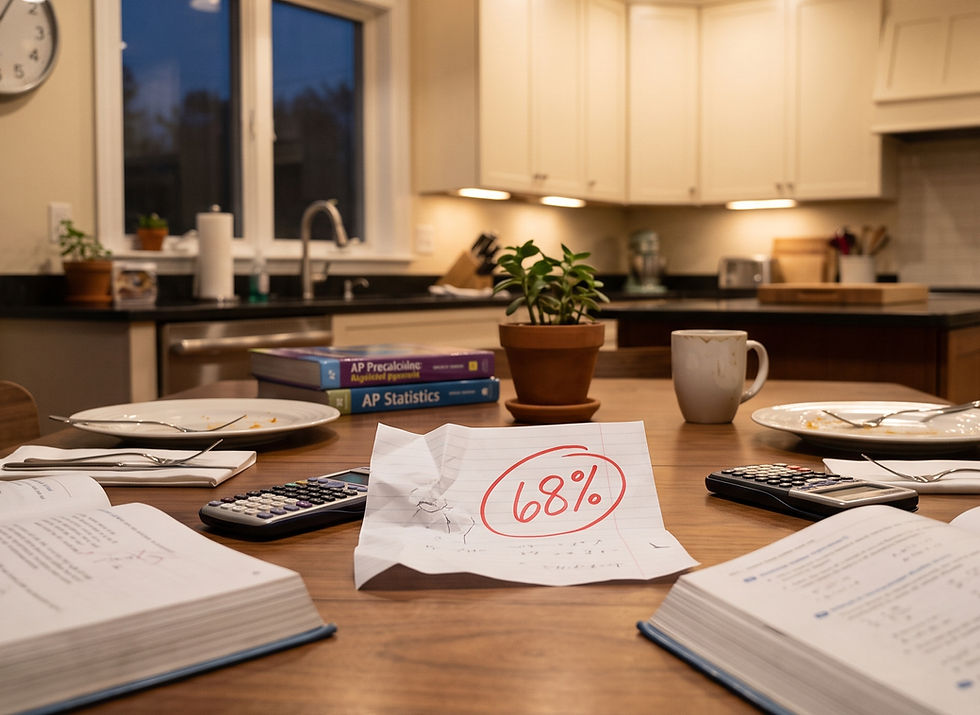
The Straight-A Surprise
Your student has done everything right. Strong grades in Algebra II. Solid work in Geometry. They signed up for AP Precalculus because they're on the STEM track, and this is the next logical step.
Then the first unit hits, and suddenly they're struggling. Not because they aren't smart — but because AP Precalculus asks a fundamentally different question than the courses that came before it. Instead of "can you follow these steps?" it asks "do you actually understand what's happening, and can you explain why?"
This is what educators call the "mastery gap" — the distance between a transcript grade and the ability to apply those concepts in a college-level modeling context. And it's more common than most families realize. When AP Precalculus launched nationally in 2023-2024, over 184,000 students enrolled. The 2025 Chief Reader Report revealed that many of those students — including high achievers — arrived with significant foundational gaps that their previous grades had masked (College Board, 2025).
Why Good Grades Don't Tell the Whole Story
The issue isn't that your student didn't learn the material. It's how they learned it.
Research in mathematical cognition shows that traditional Algebra II courses tend to develop what's called procedural fluency — the ability to execute steps and get correct answers. Students who excel in these environments often develop what researchers describe as "hoarding steps and algorithms" (Yerote Teaching, 2024). They can factor a quadratic, simplify a radical, and solve for x. And they can do it fast.
But AP Precalculus demands something different: conceptual depth. That means understanding why a function behaves the way it does, translating between verbal scenarios and symbolic models, and justifying conclusions using precise mathematical language. According to the College Board's Course and Exam Description, these "Multiple Representations" and "Communication and Reasoning" skills account for over 50% of the course weight (College Board CED).
A study published in the Journal of Numerical Cognition found that conceptual understanding moderates the relationship between procedural skill and actual achievement. Students with strong conceptual frameworks can identify shortcuts that reduce cognitive load. Students relying purely on memorized procedures must hold every individual step in working memory — and when AP Precalculus modeling tasks ramp up in complexity, that system gets overwhelmed (JNC, 2023).
In practical terms: a student who can solve a quadratic equation might not be able to explain what the vertex represents in a rate-of-change context. That's the gap.
The Four Gaps That Matter Most
Based on the College Board's prerequisite framework and national exam data, here are the specific areas where even strong students tend to fall short:
1. Algebraic Manipulation Under Pressure
Students need to factor expressions like $ax^2 + bx + c$, simplify complex fractions, and manipulate radicals — all without a calculator for parts of the exam. The gap isn't that they can't do these things. It's that they can't do them accurately across multi-step transformations when the stakes are high and the problems are layered.
2. Functional Literacy
There's a difference between knowing the definition of domain and range and actually understanding how a function behaves. The Chief Reader Report found that students frequently treat functions as "black boxes" — plugging in numbers and getting answers without understanding the process. On composition problems, many students jumped straight to a decimal answer (like 0.333) without showing the intermediate step, like identifying that f(1) = 1.75 first (College Board Chief Reader Report, 2025).
3. Trigonometric Foundations
AP Precalculus introduces the unit circle, radian measure, and sinusoidal modeling in Unit 3 — and for many students, this is their first real encounter with trigonometry beyond basic right-triangle ratios. The 2025 exam data showed a 33% gap in mastery between general function topics (53% MCQ proficiency) and trigonometric/polar function topics (20%). Students who arrive without any trig exposure face a steep climb.
4. Exponential and Logarithmic Logic

Students are expected to understand the inverse relationship between exponentials and logarithms and to conceptualize logarithms as exponents. But many students struggle to move beyond the rules, i.e. product rule for exponents, into actual reasoning — like explaining why an exponential model fits a dataset based on proportional output values over equal input intervals.
The Part Nobody Talks About: Mindset
Here's something that doesn't show up on a prerequisite checklist but matters enormously. High-achieving students often tie their identity to being "good at math," which really means being fast and accurate with procedures. When AP Precalculus asks them to slow down, reason through ambiguity, and sometimes get things wrong before getting them right, it can feel like an indictment of their intelligence.
Research on self-efficacy in mathematics shows that students whose confidence comes from getting the "right answer quickly" struggle more than those whose confidence comes from the ability to reason through a problem (ResearchGate, 2023). District leaders have emphasized the need to foster an "Advanced Is a Mindset" culture — teaching students that attitude has just as much impact on success as aptitude (College Board K-12, 2024).
This is especially important for the free-response section of the AP exam, which requires multi-part reasoning, precise notation, and persistence through unfamiliar scenarios.
What You Can Do Before Day One
The research is clear: targeted summer preparation works. A randomized controlled trial of the Elevate Math program showed a 0.7 standard deviation improvement in algebra readiness after a focused 19-day intervention (IES, 2023). And AP-specific summer boot camps have reported that 92% of participating students earned a 5 on the AP exam (Outschool, 2025).
But there's an important caveat. A Columbia University study of 1,300 students found that while summer bridge participants were 7 percentage points more likely to pass college-level math in year one, the advantage faded by the fifth semester (CCRC, Columbia). Summer prep isn't a magic bullet — it's a launchpad. The gains stick when they're reinforced during the school year.
Here's what effective summer preparation looks like:
Diagnostic assessment first. Identify the specific gaps — don't just review everything. A student who's solid on algebra but shaky on function behavior needs a different plan than one who struggles with trig basics.
Conceptual focus, not just practice problems. The goal isn't to memorize more steps. It's to build the kind of understanding that reduces cognitive load when the course gets complex.
Notation and communication practice. Get comfortable with limit notation, function composition notation, and the precise language the AP exam rewards. This is a skill that can be taught before the course even starts.
Mindset work. Normalize the idea that AP-level math feels different. It's supposed to. That discomfort is part of the learning process, not a sign that something is wrong.
Frequently Asked Questions
What are the prerequisites for AP Precalculus?
The College Board recommends proficiency in Algebra II and Geometry, including linear and polynomial functions, factoring, right-triangle trigonometry, piecewise functions, exponential rules, radicals, and complex numbers. But the real prerequisite is conceptual understanding — not just the ability to execute procedures.
The content overlaps significantly, but AP Precalculus emphasizes reasoning, modeling, and communication over raw calculation. Students report a noticeable increase in workload and a shift toward explaining why rather than just solving for what.
Can my student prepare for AP Precalculus over the summer?
Yes — and the research supports it. Targeted summer programs have shown significant short-term gains in readiness. The key is focusing on conceptual gaps (not just drilling problems) and continuing support once the school year begins.
What if my student got an A in Algebra II but still has gaps?
This is extremely common. Traditional grading often rewards procedural accuracy, which can mask gaps in conceptual understanding. A diagnostic assessment can reveal where the real gaps are.
When should we start preparing?
The earlier the better, but summer before the course is the most impactful window. This gives students time to build both skills and confidence before the pace of the course picks up.
We're building something this summer to address exactly this — a structured prep experience designed to identify and close these gaps before your student walks into AP Precalculus on day one.
Sources
College Board. (2025). 2025 Chief Reader Report: AP Precalculus. AP Central. https://apcentral.collegeboard.org
College Board. AP Precalculus Course and Exam Description. AP Central. https://apcentral.collegeboard.org
College Board K-12. (2024). Empowering Students and Expanding Access with AP Precalculus. https://k12.collegeboard.org
Education Week. (2024). By the Numbers: See How AP Precalculus Expanded Access to Advanced Math. https://edweek.org
Institute of Education Sciences. (2023). The Effects of the Elevate Math Summer Program on Math Achievement and Algebra Readiness. https://ies.ed.gov
Journal of Numerical Cognition. (2023). The Interaction of Procedural Skill, Conceptual Understanding and Working Memory in Early Mathematics Achievement. https://jnc.psychopen.eu
Community College Research Center, Columbia University. Summer Bridge Program Gives High School Students a Boost Early in College, but Benefits Fade After Two Years. https://ccrc.tc.columbia.edu
NCTM. Endless Algebra — the Deadly Pathway from High School Mathematics. https://nctm.org
ResearchGate. (2023). Self-efficacy and problem-solving skills in mathematics. https://researchgate.net

Comments