
Beat the Summer Slide: Why AP Precalculus Prep is Your Student’s Secret Weapon for Fall Success
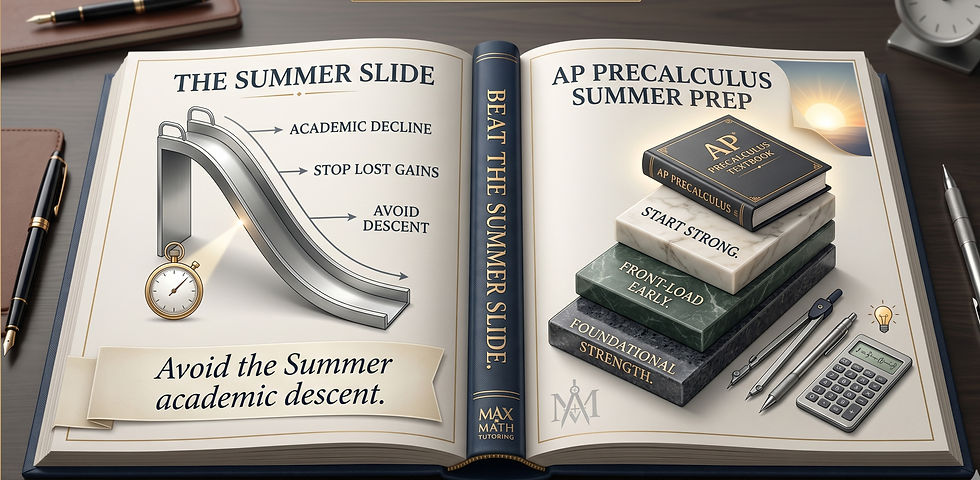
As the school year winds down, students and parents alike are eagerly looking forward to a well-deserved summer break. After ten months of early mornings, late-night study sessions, and academic stress, a three-month vacation feels like the ultimate reward.
But behind the excitement of summer lies a quiet academic threat that educators and cognitive scientists call the "summer slide"—and it hits mathematics harder than any other subject.
For students stepping into college-level STEM courses like AP Precalculus this fall, this seasonal knowledge decay isn't just a minor speed bump. It’s an instructional bottleneck that can derail their confidence, lower their GPAs, and turn their fall semester into an uphill battle.
Fortunately, you don’t have to spend your vacation grinding through dry textbooks to keep your math skills sharp. By understanding the science of how our brains process math, families can use a structured, low-stress roadmap to bypass the summer slide entirely.
The Shocking Statistics of the Math "Summer Slide"
The phenomenon of summer learning loss has been studied for over a century, beginning with William White's early research in 1906. Decades of modern, large-scale educational data have only confirmed his findings: when students disengage from structured learning over the summer, their academic skills regress.
Consider these sobering statistics:
The Average Loss: According to a landmark meta-analysis by researcher Harris Cooper, the average student loses approximately 2.6 months of grades 1-6 math skills over a single summer break.
The Compounding Effect: A massive 2020 study published in the American Educational Research Journal tracked 18 million students and found that more than half (52%) experienced documented learning losses for five consecutive summers.
The "Reteaching" Tax: Because students return to school noticeably "rusty," high school teachers must spend an average of three to six weeks of class time re-teaching old material instead of moving forward with new, grade-level concepts.
The Understudied Risk: Research on younger students consistently shows that math loss worsens with grade level and hits procedural skills hardest — making it reasonable to conclude that high school students entering AP courses with summer-eroded foundations face a real, if understudied, disadvantage.
This learning loss affects subjects differently:
Reading & Literacy: On average, students lose 1 to 2 months of school-year gains over the summer. Reading is naturally embedded in daily life through books, signs, and casual family discussions.
Mathematics: Students lose an average of 2 to 3 months of school-year gains. Math is frequently treated as a "school-only concept," meaning students rarely practice it outside the classroom.
Why Our Brains Forget Math Faster Than Reading
Why are mathematical skills so uniquely vulnerable to summer decay? The answer lies in the cognitive architecture of human memory and the specialized way our brains process mathematical tasks.
1. Procedural Memory vs. Conceptual Memory
Cognitive psychology divides our long-term memory into different systems. Declarative memory handles facts and concepts (like the definition of a function), while procedural memory governs the execution of step-by-step algorithms and computational rules.
Conceptual ideas are often retained relatively well over long breaks because they are deeply understood. However, the complex, multi-step procedures required to solve math problems—such as factoring polynomials or manipulating rational expressions—decay rapidly when left unpracticed. If you don't use those procedural pathways, the brain actively prunes them to prioritize other daily information.
2. The Bottleneck of Working Memory
Human working memory is incredibly limited. On average, we can only hold about three to seven "chunks" of novel information in our conscious minds at one time, and only for about twenty to thirty seconds.
When a student has developed automaticity—the ability to perform basic algebraic steps accurately and rapidly with zero conscious effort—those foundational skills are offloaded to long-term memory. This frees up precious slots in their working memory to focus on high-level, complex conceptual reasoning.
If a student loses that automaticity over the summer, their working memory becomes overloaded. They must dedicate conscious mental energy to basic steps like factoring or fractional operations, leaving them with zero cognitive bandwidth to comprehend the actual AP-level concepts their teacher is introducing.
Why Every Student Benefits From AP Precalculus Prep
Standard Algebra 2 classes often emphasize procedural fluency. AP Precalculus, on the other hand, demands that students analyze concepts across multiple representations: graphically, numerically, analytically, and verbally.
Whether your student sailed through Algebra 2 with an A or found certain concepts challenging, AP Precalculus represents a significant step up. In fact, even top-performing students benefit immensely from summer prep:
Transitioning from Memorization to Reasoning: Standard math classes often reward memorizing steps to pass a test. AP Precalculus, however, requires students to justify their reasoning and understand concepts deeply.
Gaining a Head Start on Relentless Pacing: College Board curricula move fast. Previewing Unit 1 (Polynomial and Rational Functions) and Unit 2 (Exponential and Logarithmic Functions) allows students to process the material at their own pace over the summer, making the fast-paced fall lessons feel like a familiar review rather than a stressful first exposure.
Locking in Fluency and Speed: High school math GPA inflation often masks minor speed deficits. A student might understand how to solve a problem but take too long doing it. Developing "automaticity"—the ability to perform algebraic steps with zero conscious effort—frees up mental space for the complex reasoning required on AP exams.
The Failure of Traditional "Summer Homework Packets"
To combat the summer slide, many high schools distribute massive, multi-page paper worksheets due on the first day of school. While teachers have excellent intentions, research shows these packets frequently fail.
Because there is no ongoing guidance, the vast majority of students procrastinate, leaving the entire packet untouched until the final forty-eight hours of summer vacation. They then rush through the problems in a state of high stress, often "borrowing" answers from peers or copying solutions online.
This "massed practice" (or cramming) creates a temporary illusion of familiarity but does nothing to build long-term retention. Even worse, it induces premature academic burnout before the school year has even started.
How to Build Durable Math Memory (The Cognitive Science Solution)
If traditional worksheets don't work, what does? Cognitive science points to three highly effective, evidence-based learning strategies that actively strengthen memory traces :
1. Spaced Practice (The Spacing Effect)
Instead of studying in one massive block, distribute your review sessions across the summer. Research shows that practicing math for just forty-five minutes, two to three times a week, dramatically improves long-term retention compared to cramming.
2. Spaced Retrieval Practice
Active recall is the single most powerful way to stabilize knowledge in long-term memory. Rather than passively re-reading old notes, challenge the brain to retrieve formulas and trigonometric values from memory using flashcards or low-stakes quizzes. For maximum retention, ensure you:
Retrieve fully: Say the answer out loud before looking at the solution.
Shuffle the deck: Mix up the order of your practice problems so your brain doesn't rely on predictable sequences.
3. Interleaved Problem Sequencing
In standard homework, students practice twenty of the same type of problem in a row (blocked practice). Interleaving involves mixing different types of problems within a single session (e.g., solving an exponential equation, then graphing a rational function, then factoring a polynomial). This forces the brain to actively choose which mathematical strategy to apply, which is exactly what they must do on actual AP exams.
The Ultimate Cure: Max's AP Precalculus Summer Prep Course
You don’t have to navigate this transition alone or spend your summer fighting over boring worksheets.
Max’s AP Precalculus Summer Prep Course is a highly flexible, self-paced online program designed to sharpen algebraic automaticity, deepen mathematical reasoning, and preview critical AP Precalculus concepts—setting students up to excel from day one, regardless of their busy summer schedules.
Why Max’s Course Actually Works:
Completely Self-Paced: Designed to fit into any schedule, anytime. Whether your student is traveling, working a summer job, or attending camp, they can complete the material on their own terms.
Engaging Video Lessons: Clear, bite-sized instructional videos break down complex ideas step-by-step, allowing students to pause, rewind, and learn at their own speed.
Graded Exams & Real-Time Feedback: Embedded, automatically graded exams give students a clear diagnostic look at their mastery, helping them measure their progress and pinpoint exactly what to refine before fall semester begins.
Interactive, Multimodal Instruction: We utilize the highly-regarded "Watch, Read, Practice" pedagogical cycle :
Watch: Engaging, highly visual video explanations that minimize cognitive load.
Read: Clear, structured study guides that build conceptual schemas.
Practice: High-quality, low-stakes practice questions with comprehensive, step-by-step worked solutions so students can immediately learn from their mistakes.
Don't let the summer slide compromise your student's GPA or STEM academic trajectory. Give them the tools, confidence, and mathematical foundation they need to thrive in AP Precalculus from day one.
FAQs
What is the "summer slide" in mathematics?
The summer slide, also known as summer learning loss, is the tendency for students to lose academic skills and knowledge over the course of a long summer vacation. On average, students lose about 2.6 months of grade-level math computational and procedural skills due to lack of practice.
Is AP Precalculus really that much harder than Algebra 2?
Yes. While Algebra 2 focuses heavily on procedural fluency, AP Precalculus is a college-level curriculum designed by the College Board to build advanced mathematical reasoning. It requires students to understand and explain functions across graphical, analytical, numerical, and verbal representations.
Why do students struggle so much in the first few weeks of AP Precalculus?
The course hits the ground running with fast-moving concepts in Unit 1 (Polynomial and Rational Functions) and Unit 2 (Exponential and Logarithmic Functions). If a student has forgotten their Algebra 2 skills over the summer, their working memory becomes overloaded, making it incredibly difficult to keep up with the pace of the class.
How does Max’s Summer Prep Course prevent learning loss?
Max's course is a self-paced, online program featuring instructional videos and graded exams that fits into any summer schedule. It uses evidence-based cognitive strategies, including spaced repetition, active retrieval practice, and interleaving, to build durable memory. By reviewing foundational Algebra 2 concepts and previewing early AP units, we ensure students retain their skills and enter the fall semester fully prepared


Comments